
Artificial intelligence (AI) is changing how people find information online. Instead of scrolling through traditional search results, many now rely on AI tools that deliver instant answers. In fact, around 43% of users utilize AI tools daily, and approximately 75% of them use these platforms more than they did a year ago.
New features like Google’s AI Overviews and AI assistants, such as ChatGPT, Perplexity, Microsoft Copilot, and Gemini, are gaining dominance online and are reshaping how brands stay visible.
- ChatGPT now has 800 million weekly active users, processing over a billion queries daily.
- Google’s AI Overviews appear in up to 16.5% of searches in countries where they rolled out.
- Perplexity AI handles over 780 million monthly searches as of May 2025, with 22 million active users.
The shift in consumer search behavior has led to changes in marketing strategies. Many marketers often describe this change as a move from SEO to GEO, and the transition is gaining momentum.
While traditional search engine optimization (SEO) remains critical for maintaining visibility in clickable search results, generative engine optimization (GEO) is emerging as a new competitive layer that focuses on being cited in AI-generated answers.
What is GEO?
Generative engine optimization, or GEO, is the practice of optimizing your content for AI-driven large language models (LLMs) and search engines that generate answers by synthesizing information from across the web. Instead of competing for a spot in a traditional list of links, GEO focuses on making your content clear, well-structured, and easy for AI systems to understand and cite in their responses.
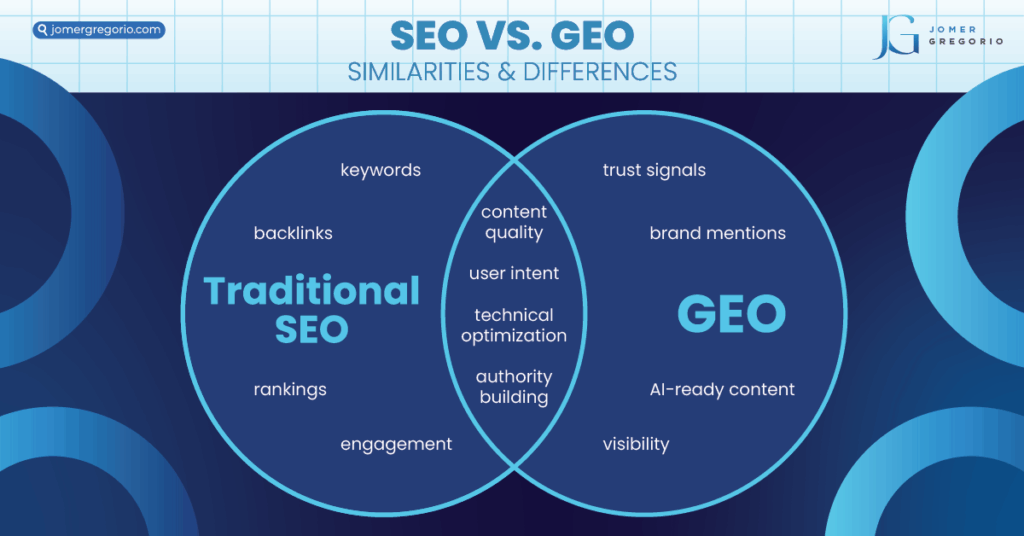
Unlike SEO, which aims to rank websites by relevance, authority, and keywords in conventional search engines, GEO targets AI models that prioritize natural language communication, semantic clarity, and precise data organization.
Why SEO Still Matters in the Age of GEO
The buzz around GEO might make you think you can abandon your traditional SEO strategies—but do not make that mistake. SEO specialists in the Philippines acknowledge that SEO remains the foundation for online success. It ensures your website appears in the familiar, clickable search results that still drive valuable traffic.
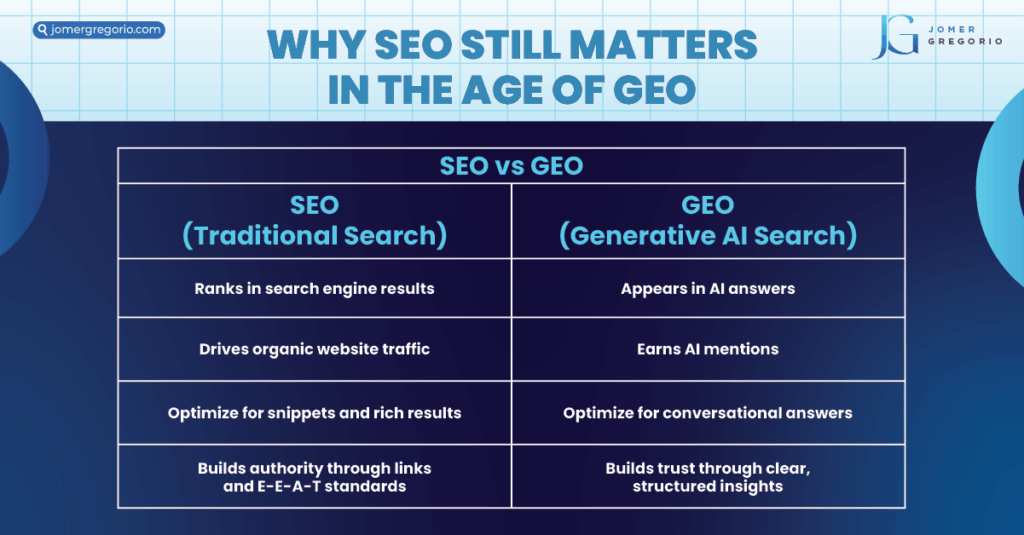
GEO does not replace SEO; it builds on it. SEO creates trust signals that generative engines rely on. Your backlinks increase authority, good site architecture shows reliability, and proper indexing and meta tags help AI crawl your pages.
Both disciplines support each other. A site strong in SEO but weak in GEO will lose visibility in AI answers. Likewise, a site strong in GEO but weak in SEO will lack authority signals that AI models depend on. This is exactly why mastering how AI and traditional SEO work together is paramount.
Traditional SEO Tactics That Still Matter
The move from SEO to GEO does not erase the importance of core SEO strategies. SEO fundamentals that build your site’s authority still hold real value.
- Keyword research. AI tools in generative search still rely on key terms to understand what your content is about.
- On-page optimization. Clear title tags, H1 to H3 headers, and internal links help organize your content. This structure makes it easier for both Google and AI models to grasp your main points and pull quotes.
- High-authority backlinks. These show trustworthiness and boost your site’s reputation. Generative engines recognize this authority and give preference to your content as a reliable source.
- Clean site architecture. An intuitive site structure helps both human users and AI bots find information efficiently.
- Mobile-first design and fast loading speed. User experience (UX) signals like speed and mobile usability remain key ranking factors. If your user experience suffers, your rankings and the trust AI give your content decline.
These classic SEO practices feed into GEO by strengthening your domain’s authority and content clarity. They lay the groundwork for your site to be seen as a trusted, go-to source. Even as AI changes search, these pillars keep their value and should not be ignored.
How Generative Search Engines Choose What to Cite
Generative search engines do not work like traditional search engines—they do not just rank pages. Instead, they “read” the entire page, convert it into complex data points called vectors, and measure how deeply the content relates to a topic. These engines pick content that is clear, factual, well-structured, and easy for AI to quote directly.
Here is what they look for:
- Strong E-E-A-T signals. Experience, expertise, authoritativeness, and trustworthiness are more critical than ever. Content that shows real expertise and reliability gets favored.
- Clear and structured content. AI prefers pages with unmistakable organization—headings, bullet lists, and internal citations—making it easy to verify facts and pull specific points.
- Deep topical coverage. AI favors sources that thoroughly cover a niche, not just surface-level information. It seeks true expert content on specific topics.
- Freshness and accuracy. Outdated or unverified content gets ignored or penalized. AI likes the most current, fact-checked data, so regular content updates are necessary.
- Multiple platform signals. A consistent brand presence across social media, industry publications, and other sites builds credibility.
- Citable statements. AI chooses paragraphs that sound complete and factual, ready to be quoted.
Generative AI uses advanced semantic analysis, so your content must answer questions clearly and richly. Clarity and depth matter more than simple metadata or keyword stuffing. To succeed in this new SEO-to-GEO marketing landscape, your content needs to be easy for AI to understand and trust, offering precise yet comprehensive answers with solid backing.
GEO-Specific Strategies to Get Cited in AI-Generated Answers
To get cited in AI-generated answers through GEO, you must write clearly for both people and machines. Here are key strategies you can use:
- Write Answer-Ready Paragraphs
Structure your content to include concise, definitive paragraphs that an AI can lift cleanly and directly. Start with the answer. For example, instead of a meandering introduction, begin a section with “Generative engine optimization, or GEO, is…”
- Use Conversational Q&A Formats
Directly address common user questions using H2 or H3 headers. This mirrors the conversational structure of tools like ChatGPT and the search engine’s natural language processing.
- Include Statistics, Definitions, and Value-Packed Summaries
Large language models favor content packed with accurate statistics, clear term definitions, and brief, value-rich summaries.
- Optimize for Information Density
Remove fluff. Each sentence should deliver maximum value with no filler. AI prefers concise and authoritative content over verbose writing.
- Add Schema Markup
Use structured data types like FAQ, HowTo, and QAPage schema to explicitly tell the generative engine what kind of information is on your page. This drastically improves AI comprehension.
- Write in Multi-Intent Formats
Address various user intents within one piece of content. Include comparison (e.g., SEO vs. GEO), definitions, how-to guides, and lists of pros and cons. Such multi-intent formats in content broaden query coverage and increase chances for AI citations.
These steps are central to the shift from SEO to GEO. AI surfaces content that is both easy to read and factually solid. By doing these, you increase the chance your content will not only rank but also appear directly in AI-generated summaries.
How to Adapt Content for Both Traditional and Generative Search
The goal is not to choose between SEO and GEO, but to optimize in two directions. Use a strategy where every piece of content performs well in both click-based ranking and AI-generated answers.
Here is the optimization process to adapt content for both traditional and generative search engines:
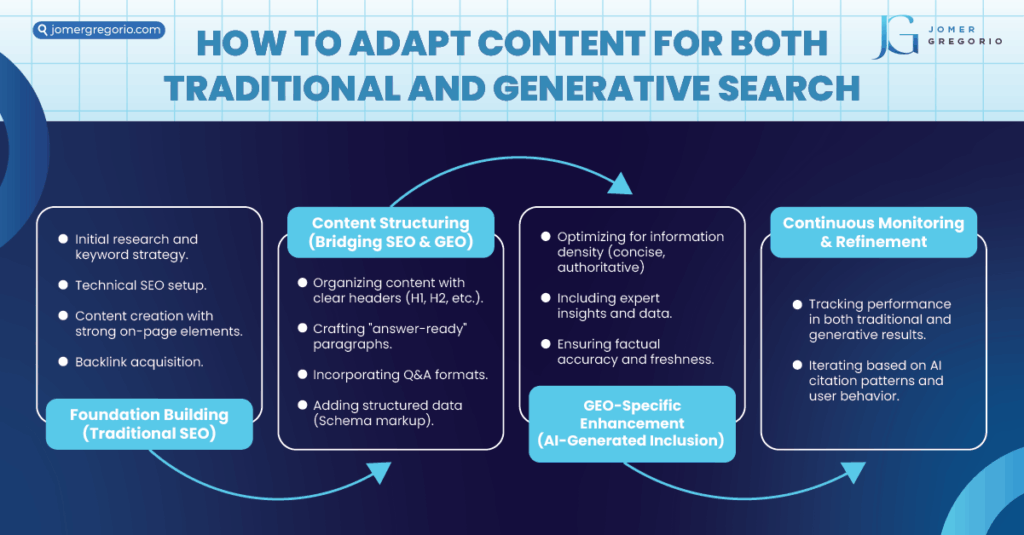
Step 1: Foundation Building (Traditional SEO)
- Initial research and keyword strategy.
- Technical SEO setup.
- Content creation with strong on-page elements.
- Backlink acquisition.
Step 2: Content Structuring (Bridging SEO & GEO)
- Organizing content with clear headers (H1, H2, etc.).
- Crafting “answer-ready” paragraphs.
- Incorporating Q&A formats.
- Adding structured data (Schema markup).
Step 3: GEO-Specific Enhancement (AI-Generated Inclusion)
- Optimizing for information density (concise, authoritative)
- Including expert insights and data.
- Ensuring factual accuracy and freshness.
Step 4: Continuous Monitoring & Refinement
- Tracking performance in both traditional and generative results.
- Iterating based on AI citation patterns and user behavior.
The transition from SEO to GEO demands a slight shift in mindset—put clarity and structure first. For example, while traditional search results reward long, comprehensive articles, generative search results reward the concise summary block inside the article. You can satisfy both by writing a deep, authoritative piece (for SEO) that clearly sections out the key answers and facts (for GEO).
Conclusion
Search is not shifting from SEO to GEO; it is expanding to include both. People often switch between traditional search results and AI-generated answers, so staying visible in both is essential.
Mastering the balance between SEO and GEO means reaching users no matter how they search. Subsequently, starting early gives you an edge in building authority, trust, and lasting traffic.
If you want your brand to stay visible in today’s AI-driven search landscape, I can help you make it happen. With more than 16 years of experience as a digital marketing and SEO consultant in the Philippines—and always staying ahead of marketing trends—I develop GEO-ready SEO strategies that get your content noticed, cited, and clicked by both people and AI engines.
Contact me today and work with a digital marketing expert who truly understands how traditional SEO and GEO connect, and how to use both to boost your online visibility and grow your business.
FAQs
What is GEO and SEO?
GEO means generative engine optimization. It helps your content appear in generative search results created by AI tools, such as ChatGPT, Perplexity, and Copilot, and AI search features like Google’s AI Overviews. Meanwhile, SEO, or search engine optimization, focuses on helping pages rank in traditional search results. It uses keywords, backlinks, site structure, and technical fixes to improve visibility.
Is GEO replacing SEO?
No, GEO is not replacing SEO. These optimization strategies support each other. SEO builds the authority that AI engines rely on, while GEO builds the clarity and structure that AI engines use to quote content.
What are the benefits of GEO?
GEO increases your chance of being included in AI-generated summaries. It helps you show up even when users never click a link. GEO improves clarity, strengthens your content structure, and makes your brand easier for AI to understand and trust. It also taps into new audience behavior as more people rely on AI for fast answers.
Why is GEO important today?
Millions of people now use AI tools as a search shortcut. They ask a question and read the summary. GEO helps you stay present in the answers people read first. If your content is not GEO-ready, you disappear from those conversations even if your SEO is strong.
What type of content works best for GEO?
Short answer blocks, clear definitions, how-to guides, comparisons, Q&A sections, and updated statistics and facts help AI engines lift your content cleanly into their responses.
Can small businesses benefit from GEO?
Yes. GEO rewards clarity and expertise more than size. A small business with helpful, well-structured content can get cited by AI engines even if big competitors dominate search rankings. GEO levels the playing field.
References
https://www.forbes.com/sites/johnwerner/2025/05/04/as-ai-use-soars-companies-shift-from-seo-to-geo
https://semji.com/ebooks/from-seo-to-geo
https://searchengineland.com/guide/good-geo-is-good-seo
https://www.linkedin.com/pulse/from-seo-geo-how-stay-visible-age-ai-search-paul-gregory-giles-yhufe
https://backlinko.com/generative-engine-optimization-geo
https://www.contentful.com/blog/seo-geo-shift-marketers-ai-search
https://digital.hec.ca/en/blog/from-seo-to-geo-how-generative-ai-is-rewriting-the-rules-of-search/