
When you set out to build an online presence, you instinctively turn to Google. For many of us, that has been the default for years—it’s fast, reliable, and deeply integrated into everyday life. But lately, a new kind of tool has begun to disrupt that default.
Artificial intelligence-driven assistants like ChatGPT are changing how people search and how they consume information online. Users are not abandoning Google entirely, but they are exploring alternatives that offer a different experience. Whenever user habits change, your marketing strategy has to evolve with them.
Why ChatGPT Is Gaining Popularity for Searches
ChatGPT is just one of the large language models (LLMs) reshaping how people explore information online. These tools respond in a conversational, human-like way, which changes how people think about online search altogether.
- Ease of Understanding and Personalized Interaction
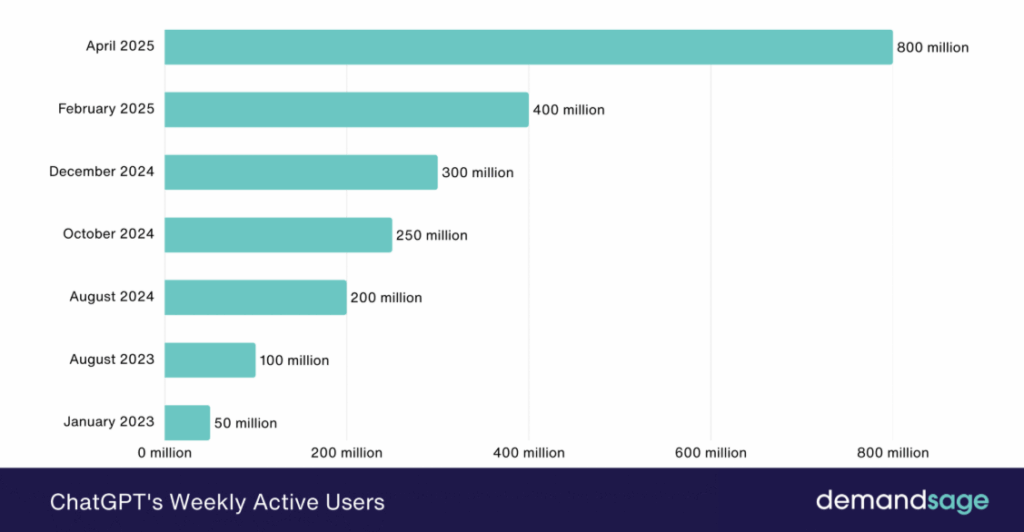
Image captured from DemandSage
More users are discovering how convenient it is to obtain a clear, comprehensive answer without having to scan through multiple links. ChatGPT simplifies explanations, organizes difficult subjects, and customizes content to the user’s specific query.
Sixty percent of adults in the US say they use ChatGPT for guidance or information. The most reliable subjects are career, education, and product recommendations.
- Creative and Open-Ended Query Handling
Sometimes people aren’t searching for facts; instead, they’re looking for perspectives, ideas, or creative guidance. About 81% of users preferred using ChatGPT for creative, open-ended questions. ChatGPT handles these kinds of queries in a manner that conventional web search engines were never intended to.
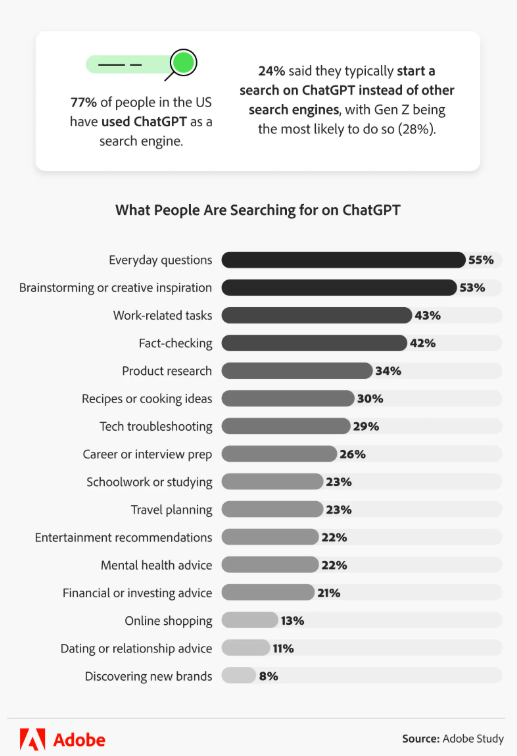
Image captured from Adobe
AI can provide interpretations and possibilities that go beyond the simple retrieval of information. This flexibility has become one of the biggest reasons people continue to use it.
- Growing Trust and Usage Across Generations
Adoption is no longer limited to tech-savvy users, as ChatGPT enters the mainstream due to AI’s convenience. Common user age demographics are:
- Ages 18 – 34: 55%
- 25 years old or younger: 45%
- Ages 55 – 64: 8.81%
- Ages 65 and older: 5.18%
As more generations build it into their daily online habits, its role in the search ecosystem continues to expand.
ChatGPT vs. Google: What’s the Difference?
Now that users are exploring both platforms, it’s worth looking at what actually sets them apart. Recognizing these shifts helps you shape a strategy that aligns with how people are now discovering and engaging with information online. Here is how they differ:
- Technology and Purpose
Google exists to index the web and guide users toward sources. It retrieves information directly from live online content and ranks it based on relevance and quality.
ChatGPT, on the other hand, is designed to generate answers using trained language models. Instead of directing users to sources, it builds a synthesized response, which creates a different user experience altogether.
- User Interaction Style
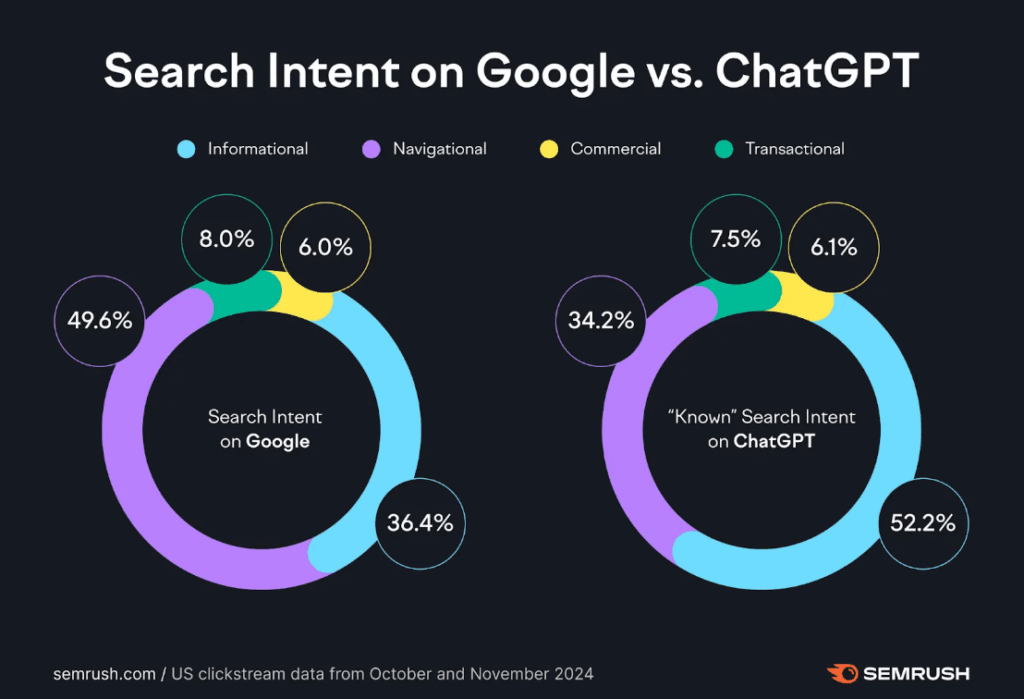
Image captured from Semrush
Users turn to Google when they expect to browse results and compare sources while they do their own filtering. It supports their research capabilities as the process requires a bit more involvement and decision-making.
ChatGPT, on the other hand, reduces that friction by providing immediate, structured answers. Many people like having the essential information readily available rather than having to navigate multiple pages.
- Speed and Efficiency
Google is exceptionally fast for users who already know what they’re looking for. A familiar link, a trusted source, or a specific page can be accessed instantly.
ChatGPT offers a different kind of efficiency, particularly in providing a clear, complete answer in one step. When users want a summarized insight rather than a list of webpages, that becomes a major advantage.
- Application and Integration
Google’s dominance also comes from its ecosystem. It powers everything from Maps to Gmail to Android, making it part of daily digital routines.
ChatGPT is catching up with integrations of its own. Users can access ChatGPT-processed data wherever they work or browse thanks to the increasing integration of AI features into apps, browsers, and productivity platforms.
Why Google Remains the Dominant Force in Search
Even with AI-driven tools gaining popularity, Google continues to hold the strongest position in online search engines. Despite ChatGPT’s launch in late 2022, Google’s queries grew over 20% since then, receiving more than 5 trillion searches a year. Here’s why:
- Extensive Market Share and User Base
Google was answering 10,000 search enquiries every day when it was established in September 1998. Now, it processes over 3.5 billion searches per day—that’s 40,000 search queries per second!
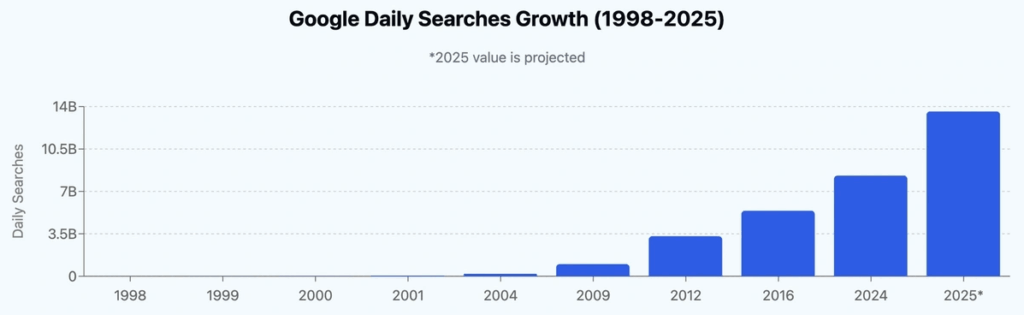
Image captured from Exploding Topics
Most users still instinctively turn to Google because it has been the standard for so long. Its scale of influence is not easy to replace, even as new habits form—Google benefits from years of deeply ingrained user behavior.
- Superior Search Quality and Ecosystem Integration
Google’s ability to provide fresh, accurate, and diverse results remains unmatched. For any local, commercial, technical, or news-related queries, users still trust Google to deliver the most reliable results.
The platform also integrates seamlessly with tools people use daily. Google’s ecosystem is a standard for users, with widely used tools such as:
- Gmail
- Google Maps
- Google Drive
- YouTube
- Google Photos
Search leverages data from users’ activity on these platforms to personalize results and ads. For instance, location data improves local business searches, and YouTube watch history influences video suggestions, creating a tightly woven user experience across products.
- Behavioral Habits and Default Settings
Many users don’t change the default search settings on their devices, primarily because Google is already set as the default on most browsers and smartphones. The platform is an overwhelmingly dominant choice worldwide, as it controls about 89.66% of the global search engine market share as of 2025.
ChatGPT vs. Google: What’s the Difference?
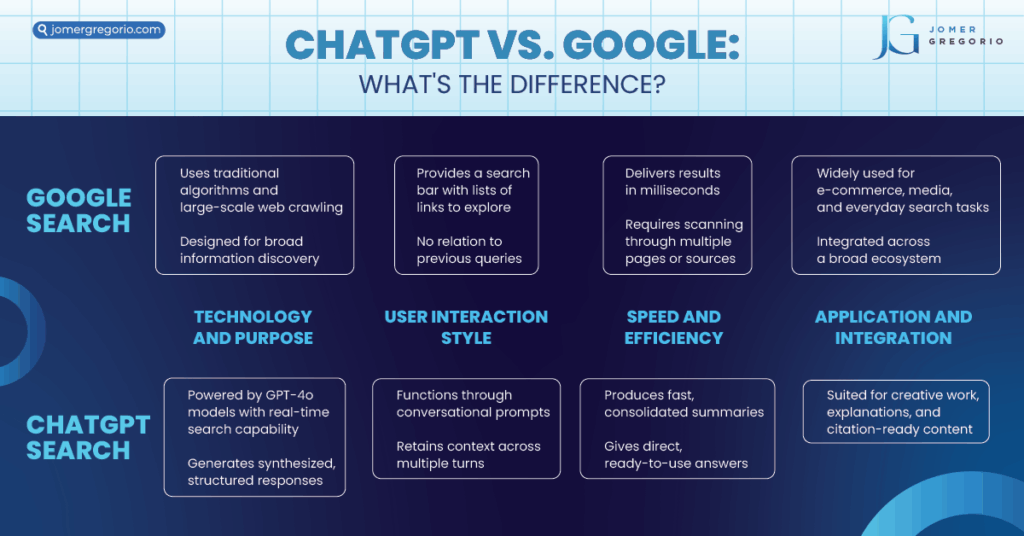
Image captured from Semrush
Those defaults shape long-term habits, with users sticking to Google due to convenience and familiarity, rarely switching unless incentivized. Even with the rise of ChatGPT, Google remains the default option for most online search activities simply because it’s always within reach.
What Can You Do to Adapt to the Growing Search Landscape
While the search environment is expanding, your strategy should never depend on a single platform. A strong digital presence needs to reach users wherever they choose to search—whether on Google, ChatGPT-powered tools, or social platforms.
- Maintain Strong SEO Foundations for Google
Google is still the biggest driver of organic traffic, so your site needs to remain technically sound and strategically planned. Focus on strengthening your E-E-A-T signals and make sure each page reflects real expertise and credibility. You also need to keep your site fast and friendly for mobile users, since performance continues to improve online search engine ranking.
- Create High-Quality, Comprehensive Content
If you want your content to stand out, it has to offer depth, clarity, and real value. When users find complete and well-structured answers on your website, it helps you rank better on Google and also positions your content as a reliable source for AI-driven tools like ChatGPT. Both Google and LLMs favor content that demonstrates expertise and relevance, so investing in high-quality writing and accurate information puts your brand ahead on multiple platforms.
- Optimize for Multi-Platform Visibility
Users no longer rely solely on a single platform to learn about a brand, so your presence has to extend beyond your website and traditional search engines. Make sure you’re visible on social media, directories, review sites, and reputable publications—these sources often help AI models understand your brand better. The more places your brand shows up, the more opportunities you create to be cited, recommended, and discovered across traditional search engines and emerging AI-driven environments.
Strengthen Your Presence in the New Search Landscape
The online search environment is evolving, and staying visible means adapting to how people ask for and consume information. Google is still powerful, but ChatGPT’s growth suggests that consumers are seeking alternative methods for decision-making and clarity.
If you want expert guidance navigating this changing landscape, I can help you build strategies that work across Google, AI-driven platforms, and multi-channel ecosystems. As an SEO Specialist, I have over 16 years of experience in assisting businesses to stay competitive and visible even as search habits evolve.
Reach out today to sharpen your digital strategy and stay ahead of the curve.
References:
https://www.businessinsider.com/chatgpt-isnt-slowing-down-google-ai-search-overviews-2025-3
https://gpt-gate.chat/news/chatgpt-april-2025-update-new-features-and-improvements/
https://www.adobe.com/express/learn/blog/chatgpt-as-a-search-engine
https://knowledge.wharton.upenn.edu/article/why-google-dominates-the-search-engine-market/