
In content marketing, producing fresh content has always been a challenge. Brands have to constantly think about offering something new or finding unique ways to present ideas to stay relevant and stand out. Keeping this up consistently and at scale can quickly build pressure.
From my years of experience as a search engine optimization (SEO) specialist in the Philippines, I have seen the best-kept secret of the industry firsthand: the most successful brands are not the ones working the hardest to always create new content, but they are the ones working the smartest to reinvent what they already have.
In 2026, this strategy will become even more critical as we navigate the age of AI search. Repurposing old content for AI search engines is how you ensure your brand becomes cited in AI-generated responses and gain visibility.
The Competitive Edge of Repurposing Old Content for AI Search
About 48% of marketers are now repurposing content across platforms rather than creating unique content from scratch for each channel (34%). This is because consistently producing entirely new content is resource-intensive. It demands time, research, and creative output at every stage.
In contrast, marketers can save one to five hours per week by repurposing old content for AI search. Not only does it speed up content production, but it also boosts sales. Based on an Adobe report, about 49% of small businesses that have started repurposing their content report experiencing an 11–25% increase in conversion.
Automation is a critical element in driving these advantages, with over half of small enterprises using generative tools to remake content faster and more economically.
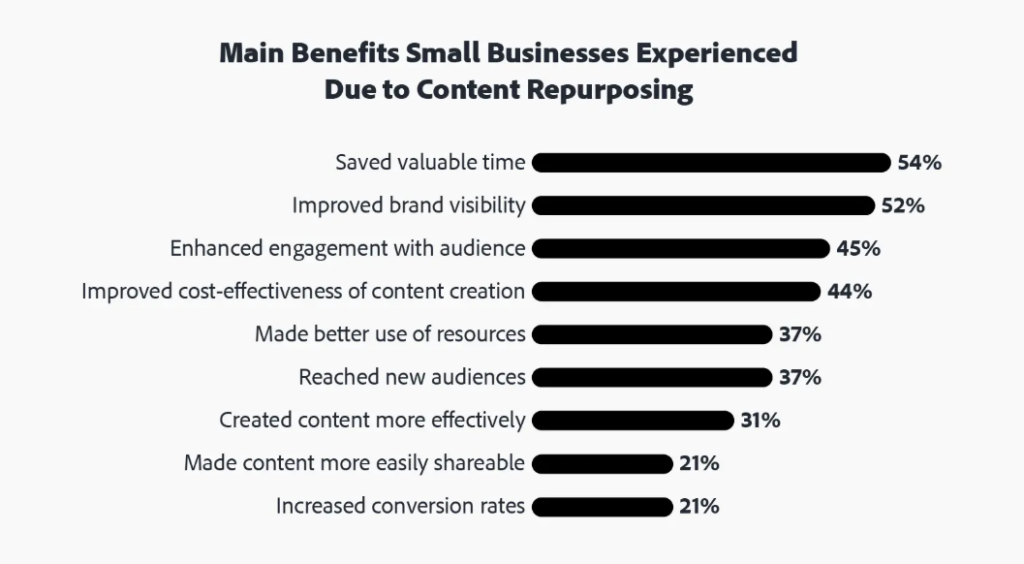
Image from Adobe
Instead of starting from scratch, brands can extract greater value by repurposing content that already performs well. For example, a 45-minute technical webinar can be sliced into five short-form video clips for social media and summarized into a data-driven blog post. This allows you to capture different audience segments across platforms with a fraction of the original effort.
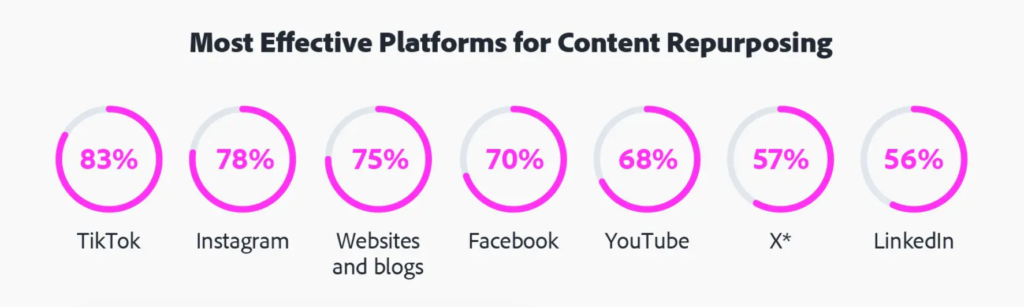
Image from Adobe
At the same time, you are establishing topical authority by providing consistent, expert answers across multiple formats. Doing this signals to the users, search engines, and AI search engines your expertise in the topic.
Which Content Should You Repurpose?
You should wait an average of 7.5 months before repurposing a piece of content. Anything that is posted over a year ago should be audited for relevance and accuracy.
Be strategic about which ones to reuse. Maximize your ROI by focusing on high-performing, evergreen content that already drives steady traffic to your site. You should also look for hidden gems with high engagement but low reach.
Here are some KPIs you can use when evaluating old content:
- Traffic: Use tools like Google Search Console (GSC) to see if the post still gets clicks. If the post once drove massive traffic, but has started to decay, it usually indicates that the topic is popular, but the specific content has lost its freshness.
- Engagement: Look for pieces with high time-on-page or conversions, even if traffic is low. These are your hidden gems that just need a new format to find an audience.
- Backlink Profile: Pages with a strong backlink profile carry historical authority. If these are repurposed, the backlinks give the new version a head start in ranking for organic search and AI citation.
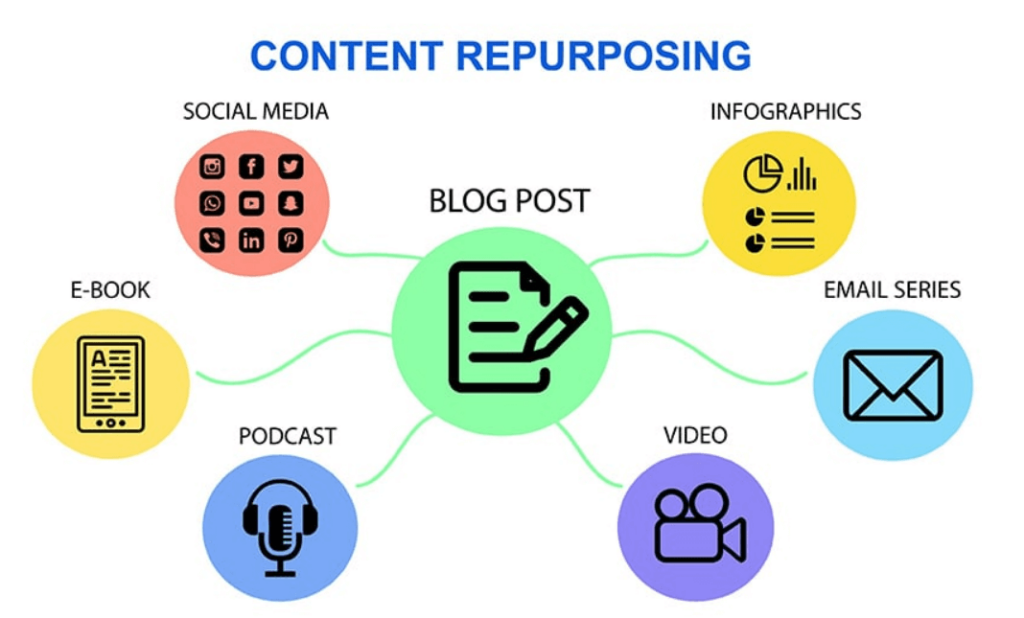
Image from Moosend
How to Repurpose Old Content for AI-generated Answers
Google’s algorithms are designed to detect duplicate or near-duplicate content to filter redundancy and ensure that users receive a diverse, high-quality search experience. However, if the repurposed version provides unique value through a different format, the engine views it as a distinct asset that satisfies a specific user intent.
To optimize content for AI search, the focus is less on rewriting everything and more on restructuring content so AI systems can easily extract and cite it. Here are some examples of how you can repurpose previously published pages and how to structure content for AI search:
Long-form Blogs to FAQ Sections
Around 78% of AI Overview responses feature list-based formatting. By breaking a 2,000-word blog into clear Q&A sections, you provide the bite-sized information that AI engines prefer for summarization. In fact, pages featuring dedicated FAQ blocks appear in an average of 4.9 AI citations.
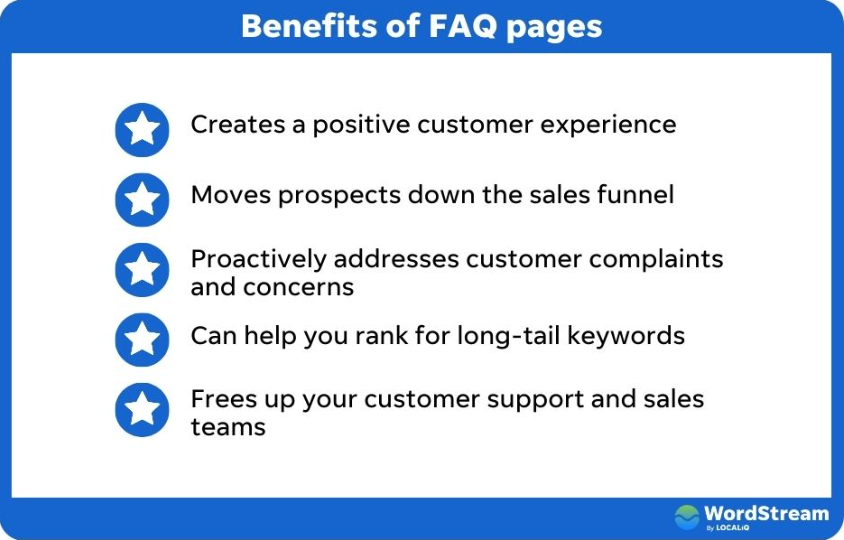
Image from Wordstream
Technical Whitepapers to How-to Guides
Research-backed content has been known to boost visibility in AI search engines by up to 40% across various queries. This makes repurposing technical whitepapers ideal because these documents contain statistics, quotations, and relevant sources that AI Overviews use, especially for technical and instructional queries.
When this type of content is formatted into structured content, like how-to guides, it becomes even more effective. In a study by Ahrefs, how-to guides receive strong visibility in AI-generated results, making up 20 to 28 of the top 50 AI-cited pages across AI Mode, AI Overviews, and Copilot.
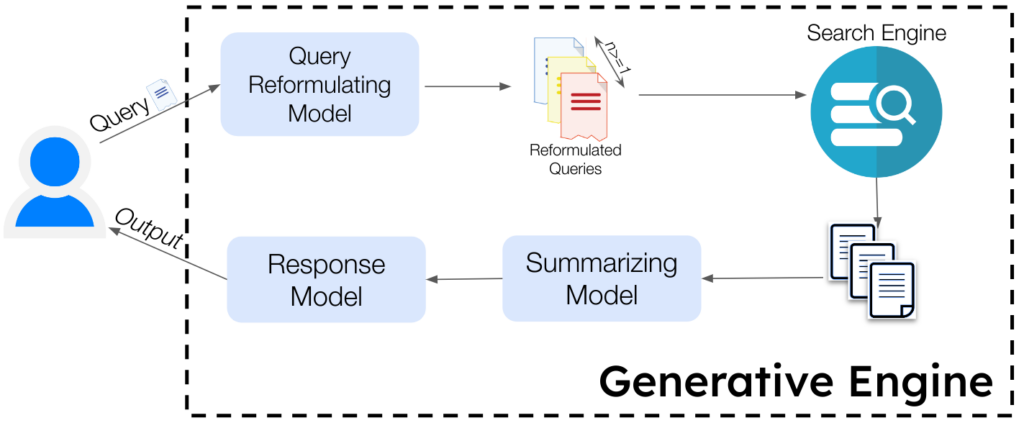
Image from arXiv
Static Reports to Original Data Tables
Repurposing static reports into original data tables makes the content more usable for AI search engines, as it transforms dense information into structured, extractable formats. Data tables provide clear ‘if-this-then-that’ relationships that are easy to parse. With this strategy, you gain 4.1 times more chances of getting an AI citation.
Webinars to Multimodal Summaries
Repurposing a long-form video into a suite of assets (clips, blogs, and social snippets) can lessen production costs by about 25.6% per content piece. Not only that, but it also increases the likelihood of AI mentions, as models inherently prefer multimodal sources. That is because cross-referencing text with video clips or images provides stronger grounding and more reliable context.
Turn Your Content Library into Growth Opportunities
The relentless cycle of create-and-forget is no longer a viable strategy for businesses seeking cost-efficient search visibility. By shifting your focus toward repurposing old content for AI search engines and partnering with an SEO expert in the Philippines, you stop the exhausting race for new ideas and start maximizing the authority you’ve already built.
If you are looking for no-fluff, expert-led guidance in turning your existing content into a high-performance asset for AI search, let’s collaborate. Contact me and let’s discuss how my expertise can boost your digital visibility.
References
https://business.google.com/us/think/search-and-video/ai-marketing-strategy-2026-guide
https://searchengineland.com/revise-old-content-ai-search-optimization-470434
https://nightwatch.io/blog/repurpose-content-for-seo
https://www.frase.io/blog/what-is-generative-engine-optimization-geo