
Demand for digital marketing services continues to rise in the Philippines. The industry generated $2.2 billion in revenue in 2023 and has since been growing at 30% year over year. This growth reflects the rising demand for digital marketing expertise in the country as enterprises rely more on online platforms to reach customers.
However, many businesses still struggle to balance online visibility with limited marketing budgets. With SEO and Google Ads becoming more competitive and costly, many companies feel pressured to choose between investing in paid advertising or long-term organic marketing. So, in a choice of SEO vs Google Ads, which strategy delivers better value?
How SEO and Google Ads Work
SEO and Google Ads are the two common strategies you can use to drive traffic to your website. But while they share the same goal, they differ in how that traffic is earned.
SEO
Search engine optimization is an organic strategy that relies on engineering a website’s technical infrastructure, content architecture, and brand signals so Google can better recognize your business as an authoritative answer to queries. Its goal is to position the site as a top result so users searching for related topics can easily discover and become familiar with your brand.
The SEO strategy is built for businesses playing the long game. If you sell premium products or services, like real estate developments or specialized medical treatments, your customers do not buy on a whim. They conduct extensive research, and SEO allows you to capture them at every stage of their research journey. By building educational trust, before they ever speak to a sales representative, you secure a massive competitive advantage.
Google Ads
Google Ads is a paid search strategy that allows you to directly place your website at the top of the search results page instead of waiting months to build organic trust with search engines. It runs on a Pay-Per-Click (PPC) model, meaning you only pay when a user actively clicks on your link, allowing you to attract users who are actively searching for related products or services.
The Google Ads strategy is built for businesses that need immediate market penetration and faster customer acquisition. It works best when your business model relies on urgent high-intent needs like emergency plumbing or immediate dental care. These customers do not search for informational blog posts but click on the first sponsored phone number or landing page they see at the top of their screen.
Visual reference:
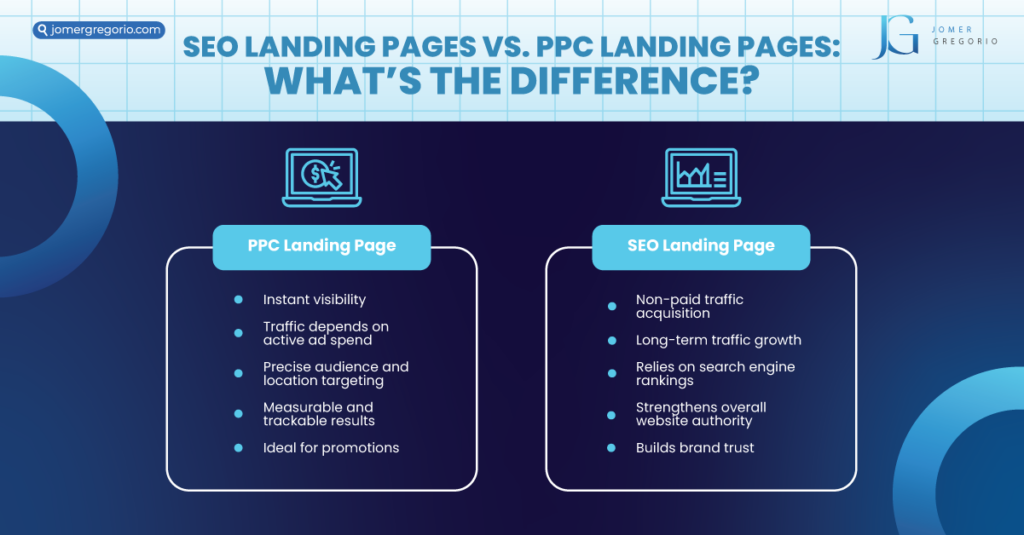
SEO vs Google Ads Differences Explained
To better understand the SEO vs Google Ads dilemma, here is a closer look at how both strategies differ.
Position in Search Results
Google Ads allow you to buy instant placement at the absolute top of the search page, clearly labeled with a “Sponsored” tag. With SEO, you earn a spot below the ads in the organic listings based entirely on your content relevance and domain authority. Your target placement within these search listings depends entirely on whether you deploy SEO vs Google Ads.
Cost Structure
When considering SEO vs Google Ads, cost is a major factor. Google Ads’ cost structure follows the PPC model, meaning every visitor costs you money. Your Google Ads cost is defined within the live keyword auction system through your Max Cost-Per-Click (Max CPC) bid and your ad’s Quality Score. When you set up a campaign, you choose a maximum amount you are willing to pay for a single click.
Google then takes your bid and multiplies it by your Quality Score. Because this happens in a live auction against other Philippine businesses, your final cost is constantly shifting based on how aggressively your competitors are bidding for those same target keywords.
In contrast, hiring an SEO team Philippines requires you to invest upfront in content and technical optimization. The actual organic clicks you receive are completely free. Currently, local SEO services in the Philippines range from $250 to $1,000 per month for small businesses needing entry-level campaigns.
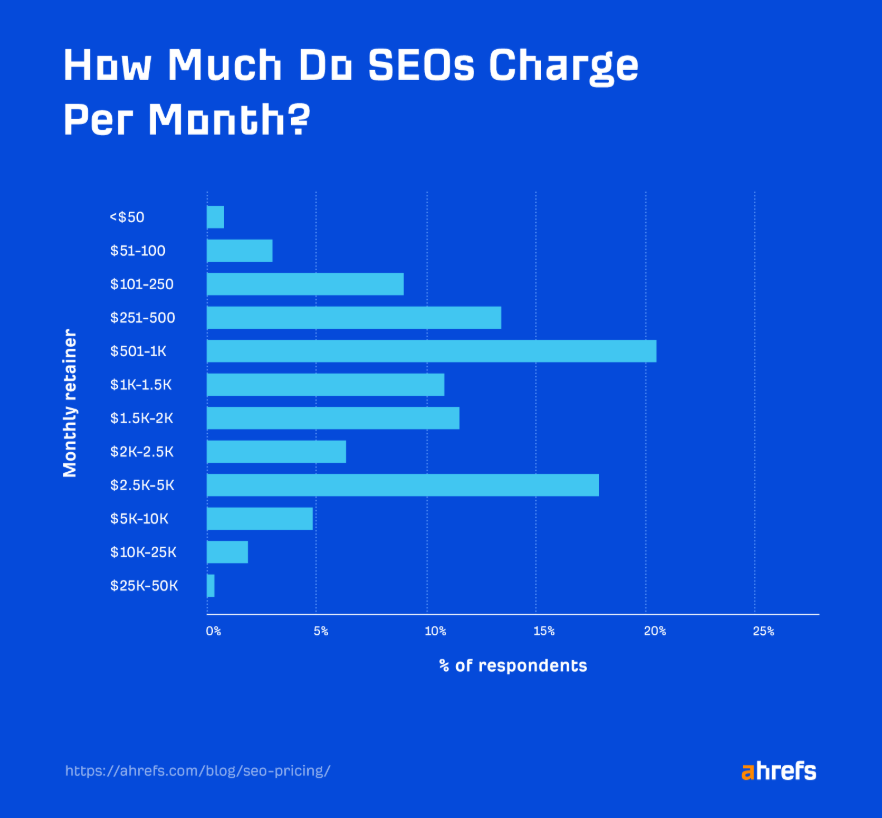
Image from Ahrefs
Speed of Results
When evaluating SEO vs Google Ads, your timeline for seeing a return on investment varies drastically. With Google Ads, you get highly targeted traffic and visibility within hours of launching a campaign. In SEO, you must build algorithmic trust, which requires consistent optimization and typically takes 3 to 6 months to rank.
Traffic Sustainability
Your visibility with Google Ads is entirely dependent on your wallet. The exact moment your budget stops, your ad traffic drops to zero. In contrast, your SEO rankings can continue generating steady organic traffic over time, especially when optimization efforts are maintained consistently. Depending on your current phase of business growth, this fundamental difference can shape your choice for SEO vs Google Ads.
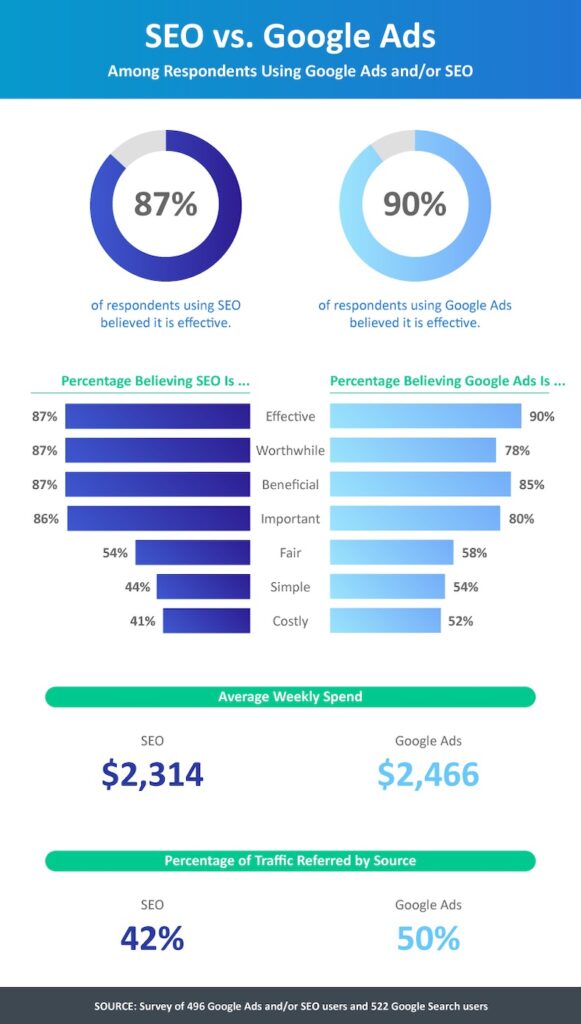
Image from MarketingProfs
Measurability
With Google Ads, you get immediate and detailed conversion data that shows exactly which keyword and ad copy led to a phone call or checkout. Meanwhile, you can track your SEO performance through keyword rankings and organic traffic growth, but tying exact revenue back to a single organic keyword takes longer to analyze. These tracking metrics provide deeper insight into how SEO vs Google Ads performs in practice.
Can you use SEO and Google Ads together?
Instead of viewing SEO and Google Ads as a competing budget item, you can actually integrate them into your marketing strategy to capture target users at every fragmented micro-moment of their purchasing journey. Some users are impulse buyers who instinctively click the topmost sponsored link; others are researchers who intentionally bypass ads to seek out authoritative organic content. By dominating both placements, you capture both demographics simultaneously.
Industry practice validates this strategy. One company reveals its strategy of using SEO links as the backbone of its overall digital marketing. The 6:1 ROI from the organic campaign acts as a financial buffer that lowers their reliance on expensive paid ads over time.
If a brand relies 100% on paid ads, its business collapses the moment they cut their budget. By using the instant data from paid ads to build a permanent organic SEO foundation, a brand can slowly dial back its ad spend if needed. The site keeps its traffic momentum because the organic search results pick up the slack.
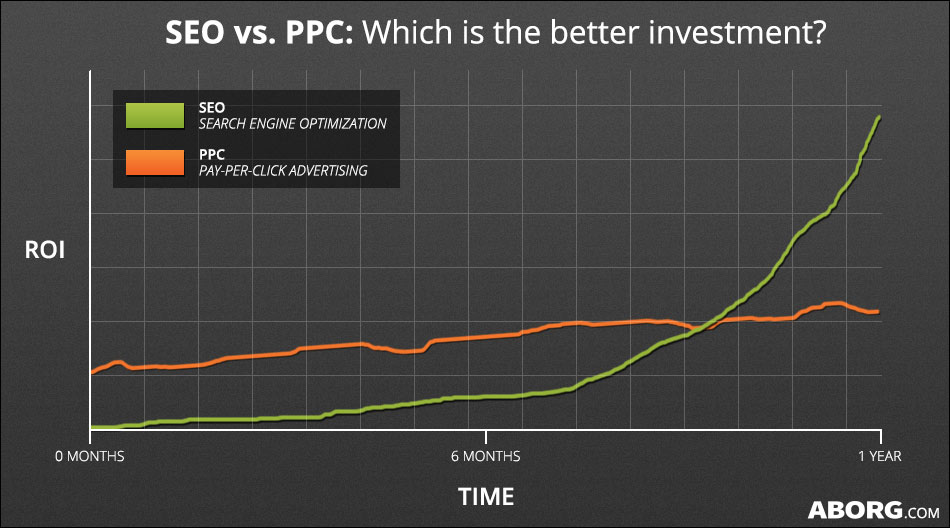
Image from Aborg
Google Ads Only Strategy
Choose this model if your business requires immediate sales, quick cash flow, or has time-sensitive promotions like flash sales or product launches. This paid model is ideal if you have a flexible, fluid marketing budget that can support ongoing advertising costs and campaign optimization.
SEO Only Strategy
Opt for this strategy if you are building long-term business equity without ongoing click fees. Hiring an SEO expert Philippines is highly effective if you have a fixed monthly budget that cannot sustain unpredictable ad bidding wars but can fund steady content asset creation.
SEO + Google Ads Strategy
This integrated SEO and Google Ads framework works best if you have an established marketing budget that can support paid ads for immediate leads while also funding your long-term organic growth. With this setup, you get the added advantage of knowing exactly which keywords drive real sales (via Google Ads conversion reporting), allowing you to target those same key phrases in your content strategy.
Conclusion
Digital marketing used to be a question of speed versus sustainability, with businesses viewing it as an SEO vs Google Ads budgeting problem. In 2026, however, continuing to view it this way could mean leaving a significant portion of your target market behind. To maximize the effectiveness of both strategies, many organizations choose to work with an experienced digital marketing consultant or specialized in-house teams.
If you want to transition from disjointed campaigns to an integrated digital marketing strategy for Philippine businesses, I can help you bridge that gap. By leveraging full-suite SEO services and data-driven digital marketing consulting, I work directly with your team to fix technical bottlenecks and scale high-converting content.
Stop wasting marketing spend on guesswork. Let’s look at your data and design a custom search framework built specifically for your business goals. Book a consultation with me today.
References
https://psa.gov.ph/statistics/digital-economy
https://www.statista.com/statistics/954885/philippines-market-share-of-search-engines
https://datareportal.com/reports/digital-2026-mid-year-global-update-report
https://ads.google.com/?subid=xs-ip-aimode-control
https://www.brightedge.com/glossary/seo-or-google-ads-which-better
https://business.google.com/us/resources/articles/seo-vs-ppc